Fish fossils are some of the most common fossils that can be found in the Peace River with a wide variety of species and types of fossils that can be found. Many are near impossible to identify, particularly once we get towards microscopic teeth.
Lepisosteidae (Gars)
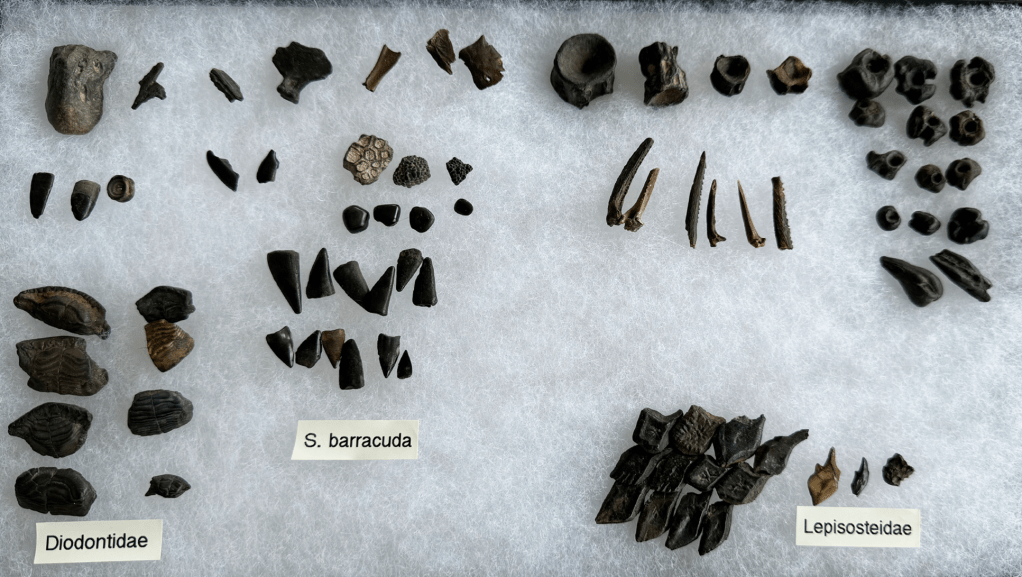
Of fish fossils gar remains are the most common in the Peace River. From Gar the most identifiable finds are the scales, vertebrae and teeth, though the teeth are microfossils and not typically found from standard sifting. Gars are still present in the Peace so be watchful for modern gar fossils, they are usually very light colored and not as hard as their fossil counterparts.
Gar scales preserve very well due to their thickness and material. They have a diamond shaped body and a “tail” that draws away from the body. They interlock together to form the armor on a gar and vary in shape and size.
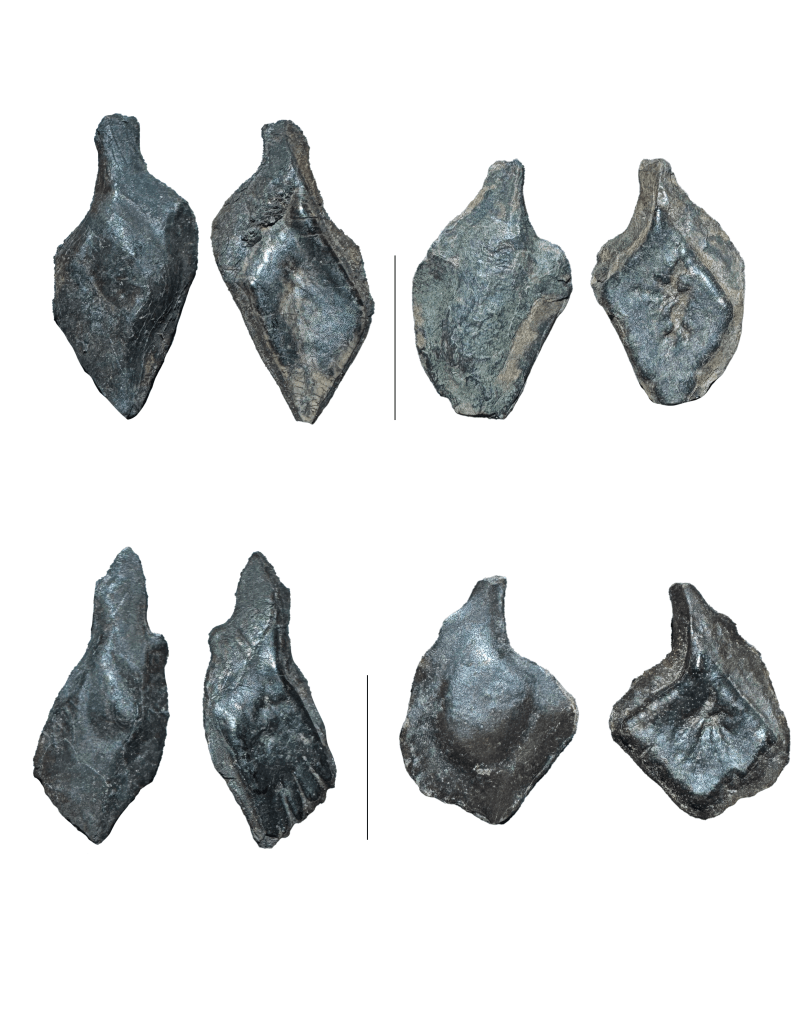

Gar vertebrae are also unique from other fish vertebrae! They have a convex anterior side and a concave posterior. The vertebrae interlock together similar to a ball and socket system.

Gar teeth are straight, narrow and striated with vertical lines running on the root of the tooth. They are incredibly small and conical, I do not have any photographs at this point as they are microfossils and unfortunately lacking in my collection.
Sphyraenidae (Barracuda)
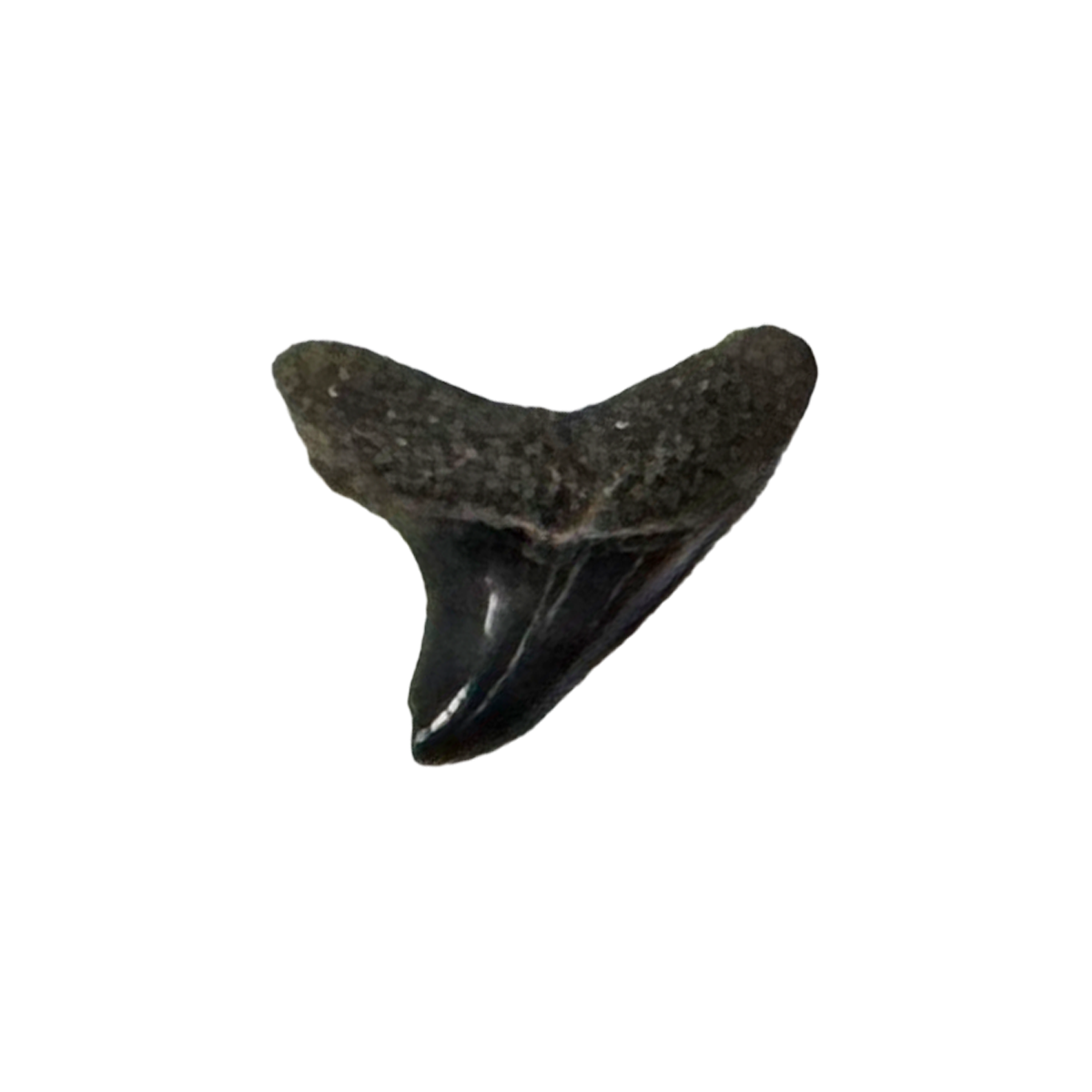
Barracuda are a large predatory fish still found in the waters around Florida. Barracuda teeth arer relatively common in the Peace River. The teeth are sharp, narrow and can be easily mistaken fora shark tooth that is missing the root. Some teeth only have 1 cutting edge with a rounded side while others are sharp on both sides and symmetrical. The teeth with 1 edge like the top two examples are the fangs from the front of the jaw while the rest of the jaw is full of the symmetrical type.

Diodontidae (Burrfish)
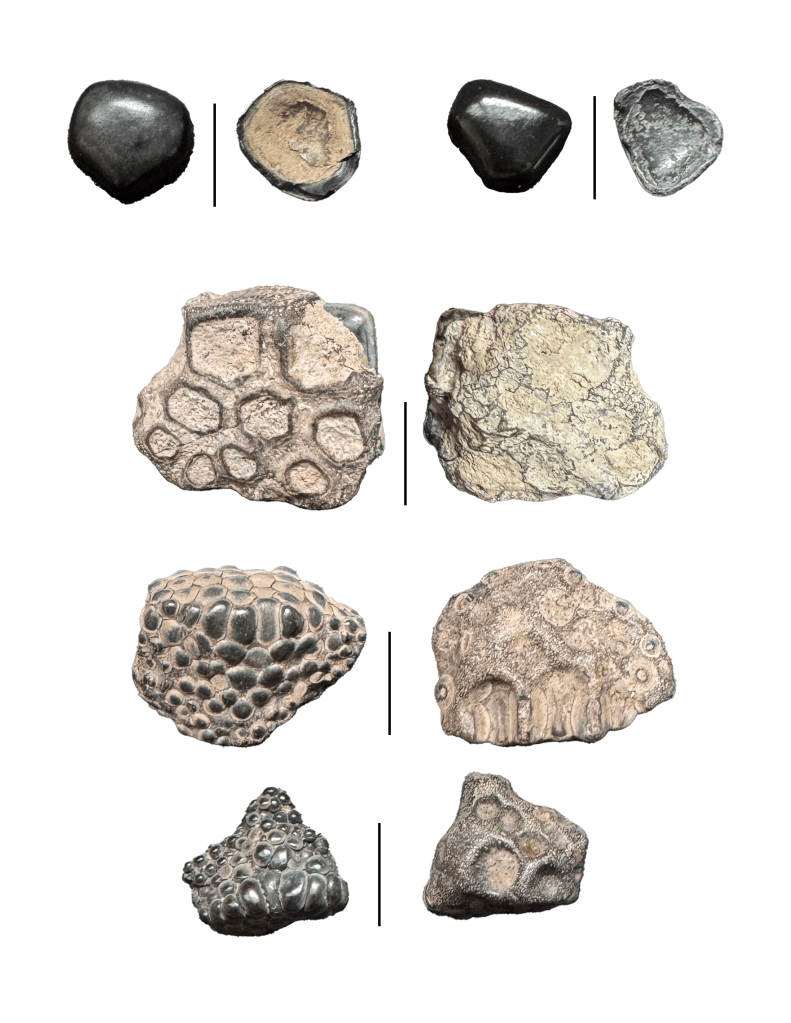
Burrfish are very similar in appearance to pufferfish but have notably different mouth plates. Their jaws resembles beaks and have a hard, boney upper and lower jaw to crush shellfish and other hard prey. There are many species of burrfish but research into species is complex and gray for the Peace River so as with most of the fish here I will leave it at family level.

Scale bar is 1cm.
Balistidae (Triggerfish)
Triggerfish teeth are rare in the Peace River but large enough to be found while screening instead of micro processing. Their teeth have a unique curve to them with a notch below the tip. They are usually well-rounded and have one smooth side that is longer than the posterior side.

Sciaenidae (Drums and croakers)
Drum fish teeth are very common in the smaller sizes of Peace River sediments. Isolated teeth resemble cups with round shiny tops and hollow insides, similar to a tooth cap. Jaws can be both in the mouth and the throat, throat jaws are called pharyngeal plates. Jaws or plates are composed of many small teeth like the two at the bottom of the image below. The complete plates are more uncommon than the individual large caps.
Ariidae (Saltwater Catfish)
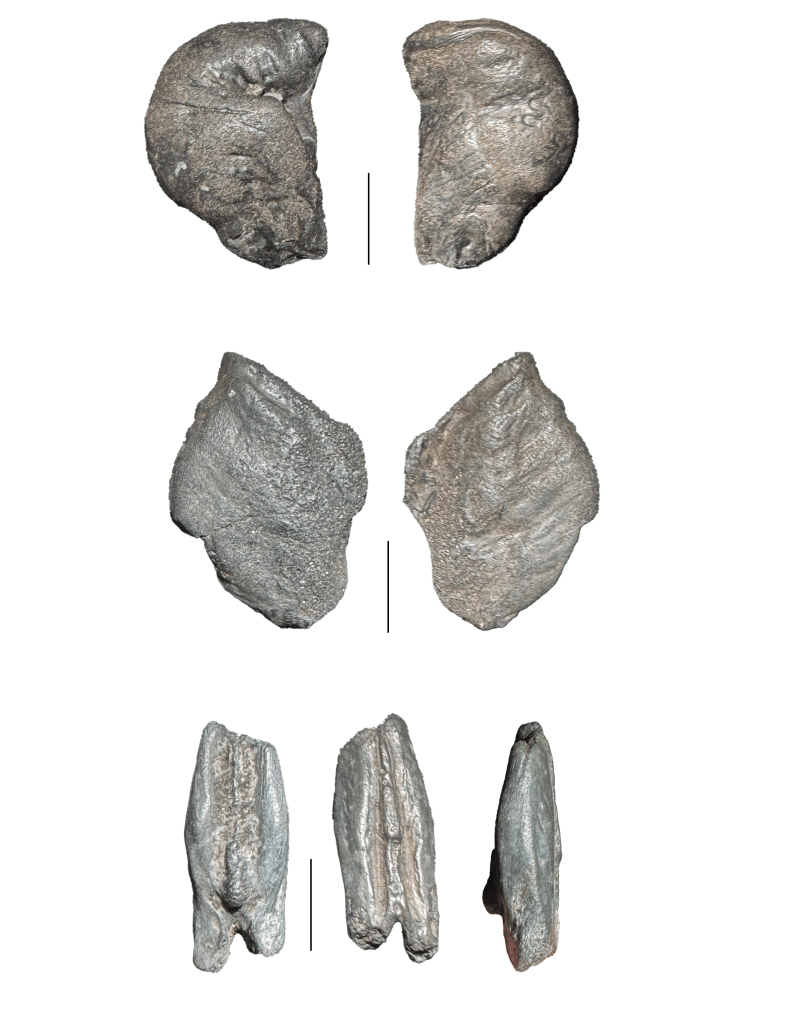
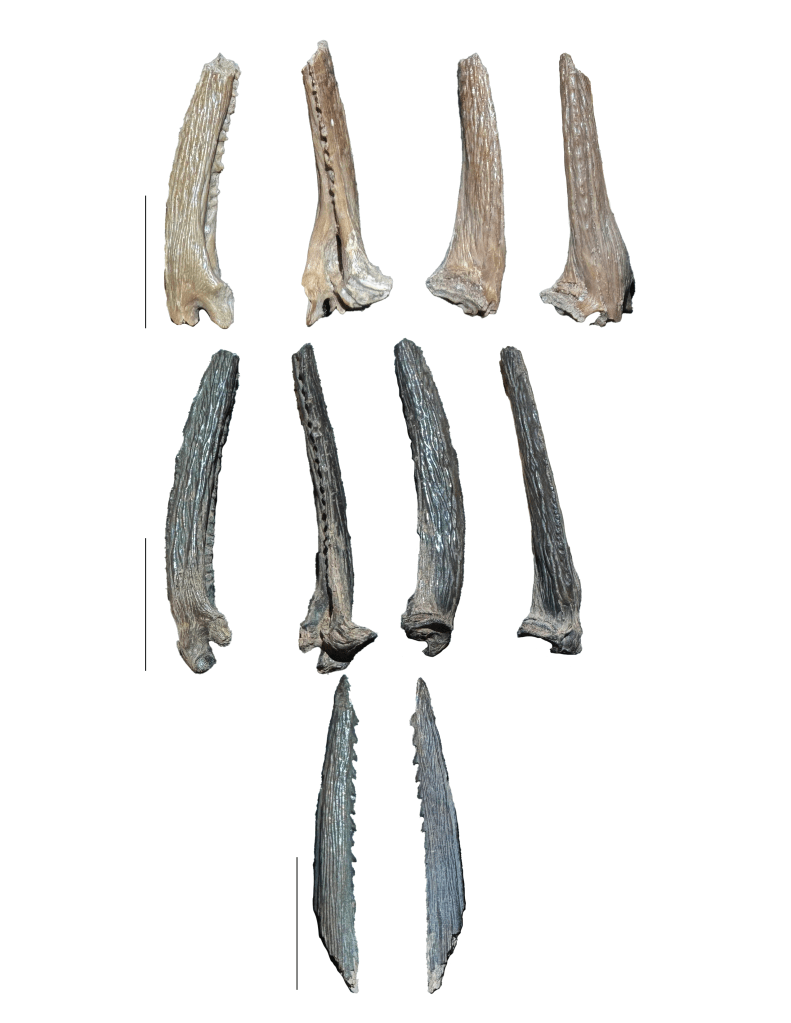
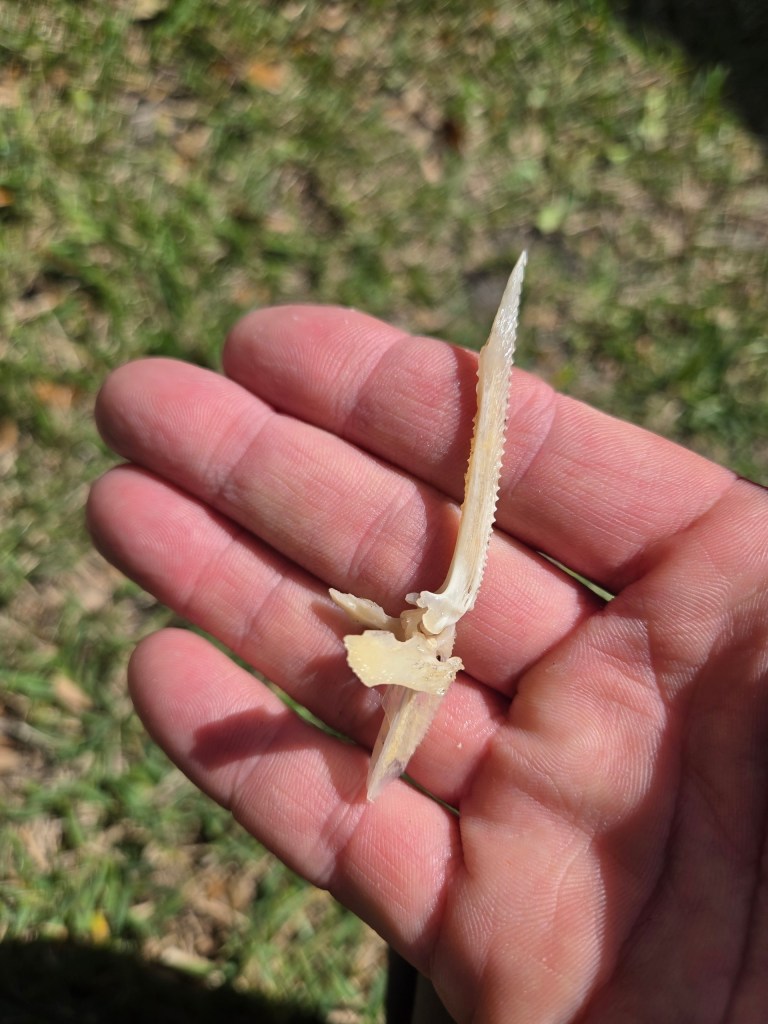
Catfish are mostly known in the Peace River from their diagnostic and barbed fin spines. Other bones such as jaws can be found but they do not have any large noticeable teeth. Saltwater catfish fin spines are on both sides and the top of the fish and provide a very strong defense against predators (and fishermen alike!). They can be identified by the odd shaped articulation at the bottom where it would meet the rest of the skeleton and the grooved sides of the spine. Well preserved spines are lined with sharp barbs.
Vertebrae
Fish vertebrae are very common finds but largely difficult to identify beyond being from one of the Osteichthyes (Bony fish). Species specific changes are apparent, such as with the gar pictured earlier and some barracuda and billfish vertebrae, but more or less I do not go further than that. The main difference from shark and fish vertebrae is the appearance of the sides, while shark vertebrae are more of less solid with few foramen on the sides, fish vertebrae are very “stringy” in appearance with grooves and a less uniform surface. View the comparison below to differentiate them.
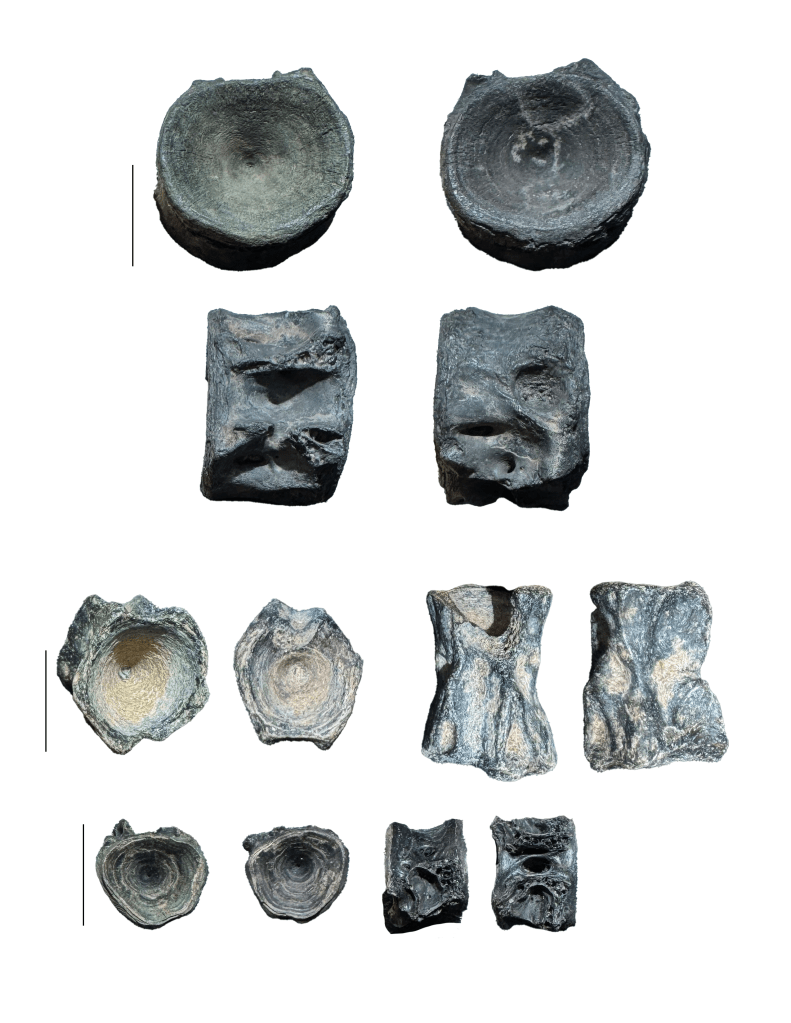

Hypural Bones
Hypural bones are the fan shaped bone found just before the tail of a fish. They come from a variety of ray-finned fish and can often be identified to a rough genus or family level. They are fragile and therefore often uncommon, the top resembles the centrum of a vertebra but instead of normal processes and an opposite side it fans out into a tail shaped disc.

Skull Pieces
Fish skull pieces are incredibly difficult to identify as anything other than being from a fish skull in some aspect. There are many bones that make up fish skulls and many species of fish present in the Peace River’s fossil record. Because of this fact I do not find it worth identifying the majority of the time due to uncertain identification and the sheer time and comparison that may not be easily searchable online. The only bones identified below are the 2 skull pieces from the Sparidae family as they have unique frontal bones. They are thick with foramina visible on the anterior aspect and an almost vertebra like appearance on the bottom. Fish skull elements are typically small and thin as seen in the specimens below. If a jaw contains teeth it may be identifiable further but the majority that I have found are unfortunately too river worn to attempt an ID.


“Tilly” Bones
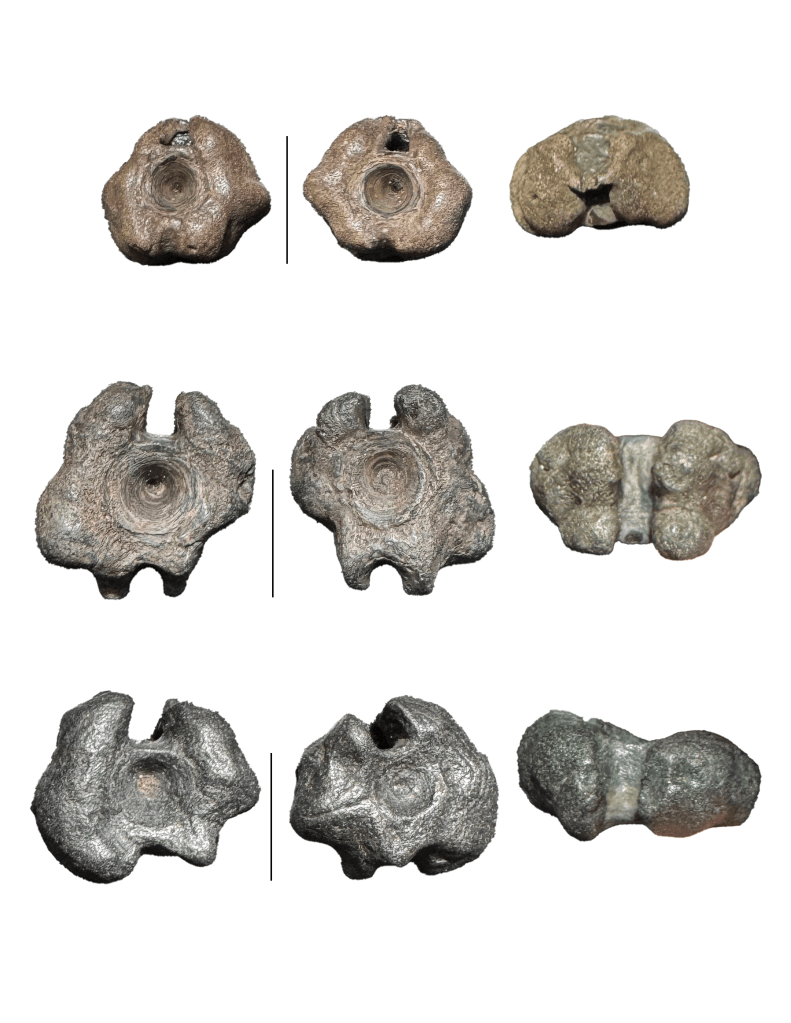
Tilly bones are fish bones with hyperostosis, meaning bones with excessive growth. Specific fish species and specific bones are affected more than others, notably fin spines, skull elements, and vertebrae being affected the most. It can be hard to differentiate the types of bones in heavily worn fossils but look for the centrum and processes of vertebrae as seen below. Tilly bones are often symmetrical, smooth and have some side of the original bone visible. The vertebrae are the most common type seen in the Peace River but there are many forms.